By Yugvender Shrivastav (YU-G) | yugvendershrivastav.com
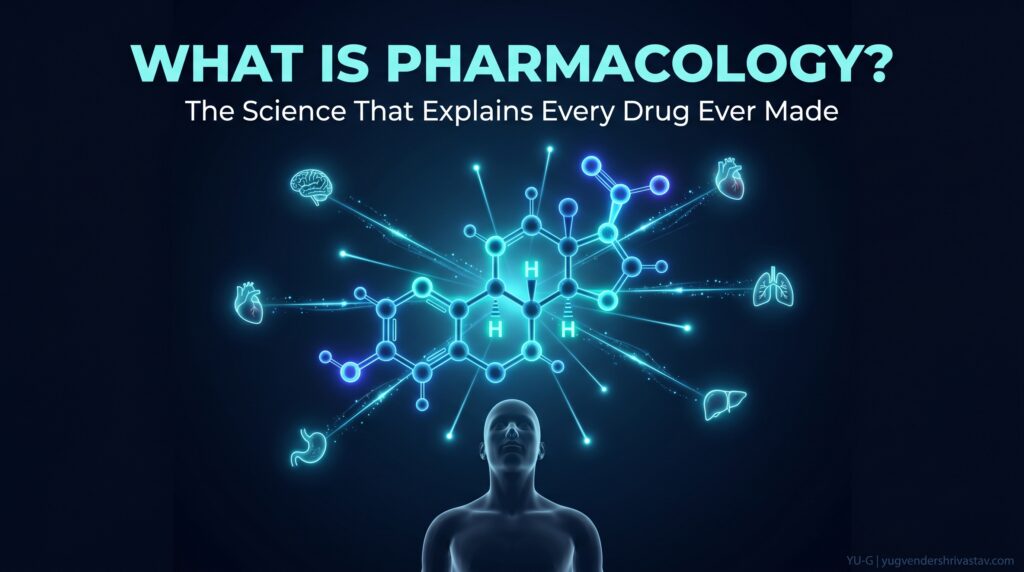
Pharmacology in One Line: Pharmacology is the scientific study of drugs — how they interact with living systems, what they do to the body, what the body does to them, and how they can be used to treat, prevent, or diagnose disease.
Every Tablet Has a Story. Pharmacology Is How You Read It.
You’ve taken a painkiller before. Maybe paracetamol for a headache, or ibuprofen after a sprain. You swallowed it. It worked. You moved on.
But have you ever stopped and thought — how did that tiny tablet know exactly where to go? How did it reduce pain without shutting down your heart? How did your body eventually get rid of it? And why does the same dose work differently for a 20-year-old versus a 70-year-old?
That’s not magic. That’s pharmacology.
And if you’re a pharmacy or medical student reading this — pharmacology isn’t just one subject in your syllabus. It’s the backbone of everything clinical you will ever do. Every prescription you’ll write, every medicine you’ll dispense, every patient you’ll counsel — it all comes back to pharmacology.
So before you dive into drug names, receptor types, and dose calculations — let’s build the foundation right.
What Is Pharmacology? (The Proper Definition)
Pharmacology (definition): The branch of biomedical science that studies the interactions between chemical substances (drugs) and living organisms — including the mechanisms of drug action, physiological effects, therapeutic uses, and adverse effects.
The word “pharmacology” comes from the Greek:
- Pharmakon — drug or poison
- Logos — study or science
That Greek root tells you something important right away: in ancient times, pharmakon meant both a cure and a poison. The same substance could heal or harm depending on the dose, the context, and the person.
That duality — drug as healer AND potential harm — is still the central tension of pharmacology today.
Paracelsus (16th century), the father of toxicology, said it best: “The dose makes the poison.” Even water is toxic at high enough doses. Even a deadly compound can save lives at the right dose. This principle is fundamental to understanding every drug that has ever existed.
Drug — What Exactly Qualifies?
Before going further, let’s define the central object of study.
Drug (definition): Any chemical substance that, when introduced into a living organism, alters its physiological or biochemical processes — used for the diagnosis, treatment, prevention of disease, or modification of a biological function.
A drug can be:
- A small synthetic molecule (like aspirin)
- A biological agent (like insulin — a protein)
- A natural compound (like morphine — derived from the opium poppy)
- A radioactive isotope (used in nuclear medicine imaging)
- An antibody (like monoclonal antibodies used in cancer therapy)
The key requirement? It must interact with a biological system and produce a measurable change.
The Two Core Pillars of Pharmacology
All of pharmacology — every drug, every mechanism, every clinical application — sits on two foundational concepts. Understand these two, and everything else clicks into place.
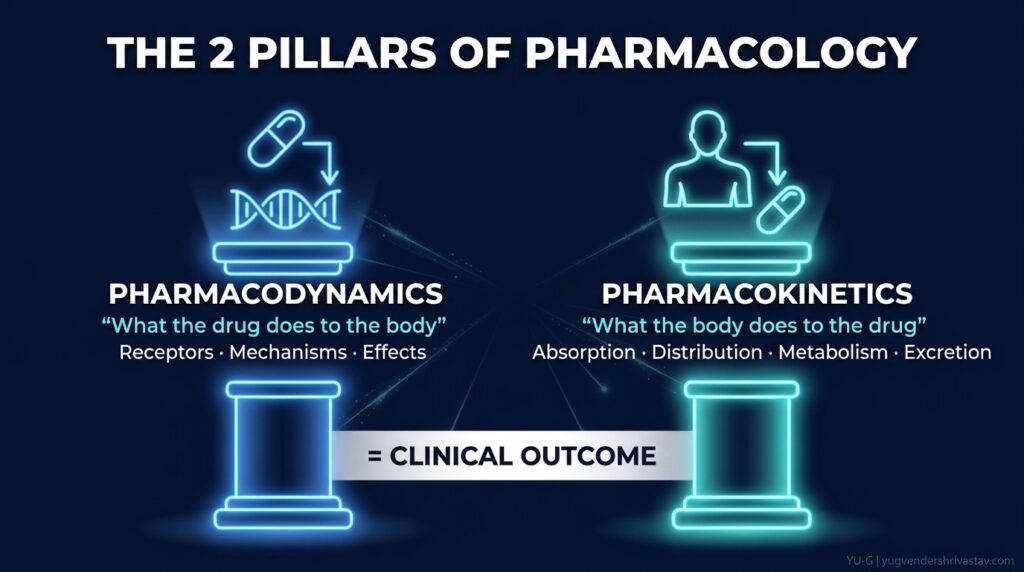
Pillar 1: Pharmacodynamics (PD) — What the Drug Does to the Body
Pharmacodynamics (definition): The study of the biochemical and physiological effects of drugs on the body, and the mechanisms through which they produce these effects.
Simply: Pharmacodynamics = Drug → Body
This is where you study:
- How a drug binds to its receptor
- What happens after binding (agonism, antagonism, partial agonism)
- The relationship between dose and response
- Concepts like efficacy (maximum effect a drug can produce) and potency (how much drug you need to produce an effect)
- Selectivity — why a drug affects one tissue and not another
Analogy: Think of a drug as a key and a receptor as a lock. Pharmacodynamics studies whether the key fits the lock, what door it opens, and what room you end up in once it does.
Pillar 2: Pharmacokinetics (PK) — What the Body Does to the Drug
Pharmacokinetics (definition): The study of how the body absorbs, distributes, metabolizes, and eliminates a drug over time — determining how much drug reaches its site of action and for how long.
Simply: Pharmacokinetics = Body → Drug
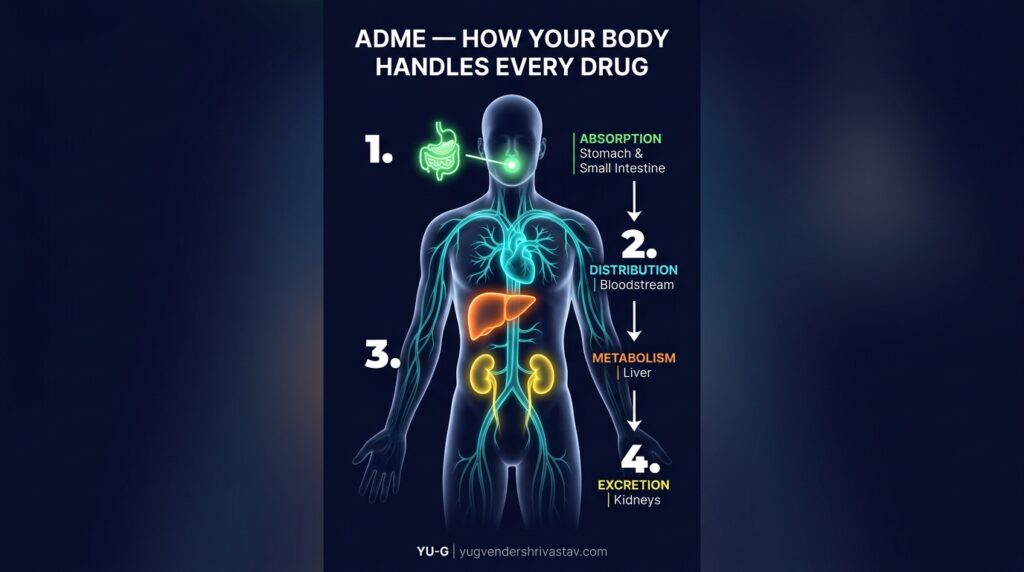
This is the ADME framework — the four processes every drug goes through:
| Process | What Happens | Key Concept |
|---|---|---|
| Absorption | Drug enters the bloodstream | Bioavailability |
| Distribution | Drug spreads to tissues/organs | Volume of distribution |
| Metabolism | Drug is chemically modified (mainly liver) | First-pass effect, CYP enzymes |
| Excretion | Drug is eliminated from the body | Half-life, renal clearance |
Analogy: Pharmacokinetics is like tracking a delivery package. Absorption = the package leaves the warehouse. Distribution = it travels to different cities. Metabolism = it gets repackaged at a hub. Excretion = it reaches the final destination and gets disposed of.
PD + PK together: A drug can have excellent pharmacodynamics — perfect receptor fit, powerful effect — but if its pharmacokinetics are poor (not absorbed, metabolized too fast, can’t reach the target), it fails as a medicine. Both pillars must work together for a drug to succeed clinically.
(For a deep dive into each of these, check out our upcoming posts: “Pharmacodynamics Explained Simply” and “ADME: How Your Body Processes Every Drug You Take.”)
The Scope of Pharmacology — What It Covers
Pharmacology is not a single, narrow subject. It is an expansive, interconnected science with multiple branches — each focusing on a different aspect of drug science. Here’s the full map.
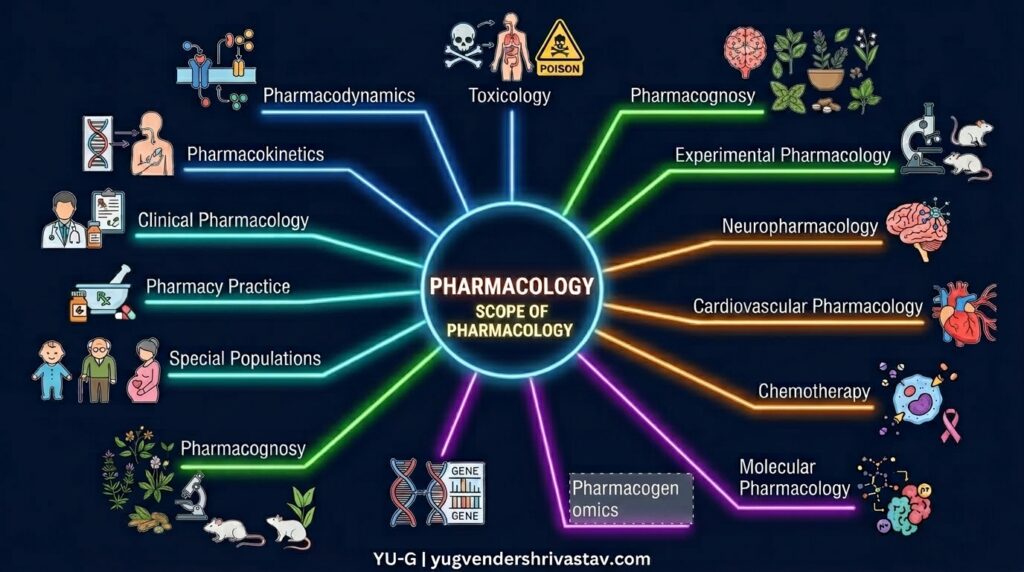
1. 🧬 Pharmacodynamics
The study of drug-receptor interactions, mechanisms of action, dose-response relationships, and the molecular basis of drug effects. (Covered above as Pillar 1.)
2. 🔄 Pharmacokinetics
The study of drug absorption, distribution, metabolism, and excretion — the ADME framework. (Covered above as Pillar 2.)
3. ☠️ Pharmacotoxicology (Toxicology)
Toxicology (definition): The branch that studies the harmful, toxic, or adverse effects of drugs and chemicals on living organisms — including mechanisms of toxicity, dose-response for harm, and management of poisoning.
Every drug has a therapeutic window — a dose range where it’s effective without being harmful. Toxicology studies what happens when this window is crossed, either by overdose, drug interaction, or individual sensitivity.
This branch is critical for:
- Drug safety evaluation during development
- Management of drug overdoses and poisoning
- Understanding side effects and adverse drug reactions (ADRs)
4. 🌿 Pharmacognosy
Pharmacognosy (definition): The study of drugs derived from natural sources — plants, animals, fungi, and minerals — including their identification, extraction, active constituents, and biological activity.
This is the oldest branch of pharmacology. Before synthetic chemistry existed, all medicines came from nature. Pharmacognosy is why:
- Morphine came from the opium poppy (Papaver somniferum)
- Aspirin was derived from salicin in willow bark
- Penicillin was discovered from the Penicillium mold
- Taxol (paclitaxel) — a powerful cancer drug — comes from the Pacific yew tree
Even today, over 50% of approved drugs are either directly derived from natural sources or inspired by natural compounds.
5. 🏥 Clinical Pharmacology
Clinical pharmacology (definition): The application of pharmacological principles in human subjects — studying how drugs behave in real patients, including efficacy, safety, dosing, and drug interactions in diverse populations.
This is pharmacology meeting the real world. It bridges the gap between laboratory findings and actual patient care.
Clinical pharmacology covers:
- Clinical trials — Phase I through Phase IV drug testing
- Therapeutic drug monitoring (TDM) — measuring drug levels in patients to optimize dosing
- Individualized drug therapy — adjusting doses for elderly patients, renally impaired patients, pediatric patients, pregnant women
- Drug interactions — understanding when two drugs combined produce unexpected effects
6. 🧪 Experimental Pharmacology
The use of laboratory models — cell cultures, animal studies, and in vitro experiments — to study drug effects before clinical application.
This is where drug development begins. Before any new molecule reaches a human, it goes through years of experimental pharmacology to test efficacy, safety, and mechanism of action.
7. 💻 Clinical Pharmacy / Pharmacy Practice
The translational arm — applying pharmacological knowledge directly in clinical settings. This includes:
- Medication counseling
- Drug therapy optimization
- Adverse drug reaction monitoring
- Prescription review and drug information services
This is where pharmacy students live once they graduate.
8. 🧬 Molecular Pharmacology
The study of drug interactions at the molecular and genetic level — receptor structure, signal transduction pathways, gene expression changes caused by drugs.
This is the frontier of modern pharmacology and the foundation of personalized medicine.
9. 🧠 Neuropharmacology
The study of drug effects on the nervous system — including drugs that treat depression, anxiety, epilepsy, Parkinson’s disease, schizophrenia, and pain.
One of the most complex and rapidly evolving branches, given the complexity of the brain.
10. ❤️ Cardiovascular Pharmacology
The study of drugs affecting the heart and blood vessels — antihypertensives, antiarrhythmics, anticoagulants, lipid-lowering agents, and heart failure medications.
11. 🦠 Chemotherapy / Pharmacology of Infectious Disease
The study of antimicrobial, antiviral, antifungal, antiparasitic, and anticancer agents — how they selectively target pathogens or cancer cells while minimizing harm to the host.
Selective toxicity — the ability to kill an invader without killing the host — is the central challenge and goal of this entire branch.
12. ⚗️ Pharmacogenomics
Pharmacogenomics (definition): The study of how an individual’s genetic makeup influences their response to drugs — enabling personalized, precision medicine.
Two patients take the same drug at the same dose. One responds well. The other has a severe adverse reaction. Why?
Genetics. Differences in genes encoding drug-metabolizing enzymes (like CYP2D6, CYP2C19), drug transporters, and drug targets explain much of the variability in drug response between individuals.
Advanced insight: Pharmacogenomics is rapidly reshaping prescribing. For example, patients who are CYP2D6 poor metabolizers cannot effectively convert codeine into its active form (morphine) — making codeine ineffective and risky for them. Genetic testing before prescribing certain drugs is already standard practice in some countries and is the direction all of medicine is heading.
13. 🧒 Special Populations Pharmacology
How drug pharmacokinetics and pharmacodynamics differ in:
- Pediatrics — immature enzyme systems, weight-based dosing
- Geriatrics — reduced renal/hepatic function, polypharmacy risks
- Pregnancy — teratogenicity, placental drug transfer
- Renal/hepatic impairment — altered drug metabolism and elimination
How Pharmacology Connects to Every Healthcare Discipline
Pharmacology doesn’t exist in isolation. It is the connective tissue of all health sciences:
| Discipline | How Pharmacology Connects |
|---|---|
| Medicine | Rational drug prescribing; mechanism-based treatment |
| Pharmacy | Drug dispensing, counseling, interactions, TDM |
| Nursing | Safe drug administration, ADR monitoring |
| Dentistry | Local anesthetics, analgesics, antimicrobials |
| Biochemistry | Drug-enzyme interactions, metabolic pathways |
| Physiology | Understanding normal function to recognize drug effects |
| Pathology | Disease mechanisms that drugs target |
| Biotechnology | Biological drug development, gene therapy |
The Drug Development Pipeline — From Lab to Patient
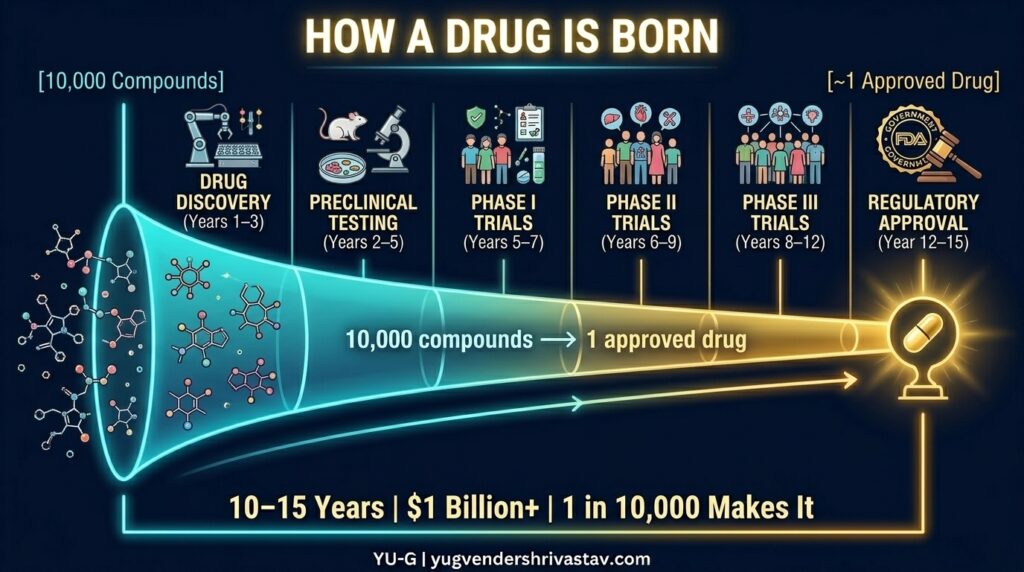
Understanding pharmacology’s scope also means understanding how a drug is born:
Step 1 — Drug Discovery Target identification (what biological molecule to act on?) → Lead compound identification → Optimization
Step 2 — Preclinical Testing Animal and in vitro studies for efficacy, safety, and pharmacokinetics. Most compounds fail here.
Step 3 — Clinical Trials
- Phase I — Safety in healthy volunteers; dose-finding
- Phase II — Efficacy and safety in small patient groups
- Phase III — Large-scale randomized controlled trials vs. placebo or standard care
- Phase IV — Post-marketing surveillance; long-term safety in real-world populations
Step 4 — Regulatory Approval Submission to regulatory agencies (CDSCO in India, FDA in USA, EMA in Europe) for review and approval.
Step 5 — Post-Marketing Pharmacovigilance — ongoing monitoring for adverse effects not detected in trials.
On average, this entire process takes 10–15 years and costs over $1 billion per approved drug. Of every 10,000 compounds discovered, roughly 1 makes it to market.
Why Pharmacology Is the Most Important Subject You’ll Study
Here’s something your textbook won’t tell you explicitly:
Every clinical error involving a drug — wrong dose, dangerous interaction, missed contraindication, untreated adverse reaction — is fundamentally a failure of pharmacological understanding.
When a doctor prescribes the wrong drug for a patient with renal failure, that’s a pharmacokinetics failure. When a pharmacist misses a drug-drug interaction, that’s a pharmacodynamics failure. When a nurse administers the right drug by the wrong route, that’s an applied pharmacology failure.
Pharmacology is not abstract science. It is patient safety. It is clinical competence. It is the difference between a drug that heals and a drug that harms.
That’s why every healthcare professional — not just pharmacists — must understand it deeply.
Conclusion: The Foundation Everything Else Is Built On
Pharmacology is where chemistry meets biology meets clinical medicine. It explains the why behind every drug decision — why this drug, why this dose, why this route, why this patient needs monitoring.
As you go deeper into your studies, you’ll encounter hundreds of drug names, dozens of receptor types, and complex clinical scenarios. But every single one of them traces back to the principles you’ve just read here.
Build the foundation right. The rest becomes logical — not just memorized.
✨ Featured Snippet Answer
What is pharmacology and what does it study? Pharmacology is the scientific study of how drugs interact with living systems. It encompasses two core pillars — pharmacodynamics (what drugs do to the body) and pharmacokinetics (what the body does to drugs) — along with branches covering toxicology, clinical applications, drug development, pharmacogenomics, and more.
📌 Key Takeaways
- Pharmacology is the science of drug-living system interactions — covering mechanisms, effects, uses, and safety
- “The dose makes the poison” — Paracelsus’ principle remains the foundation of all drug science
- Pharmacodynamics = what the drug does to the body (receptors, mechanisms, effects)
- Pharmacokinetics = what the body does to the drug (ADME — Absorption, Distribution, Metabolism, Excretion)
- Both PD and PK must work together for a drug to succeed clinically
- The scope of pharmacology spans 13+ branches — from toxicology and pharmacognosy to pharmacogenomics and neuropharmacology
- Over 50% of approved drugs originate from or are inspired by natural sources
- Drug development takes 10–15 years and $1 billion+ on average — and only 1 in 10,000 compounds reaches market
- Pharmacology underpins patient safety — clinical errors involving drugs are fundamentally pharmacological failures
- Pharmacogenomics is the future — genetic variation explains why the same drug works differently in different people
❓ FAQ Section
Q1: What is pharmacology in simple terms? Pharmacology is the science of drugs — studying what they are, how they work in the body, what effects they produce, how the body processes and eliminates them, and how they can be used safely to treat or prevent disease. It bridges chemistry, biology, and medicine.
Q2: What are the two main branches of pharmacology? The two foundational branches are pharmacodynamics — the study of what drugs do to the body (mechanisms, receptor interactions, effects) — and pharmacokinetics — the study of what the body does to the drug (absorption, distribution, metabolism, excretion). All of pharmacology builds on these two pillars.
Q3: What is the difference between pharmacology and pharmacy? Pharmacology is a basic science focused on understanding how drugs work at a biological and molecular level. Pharmacy is an applied health profession focused on the preparation, dispensing, and clinical use of medications. Pharmacology is the scientific foundation; pharmacy is its clinical application.
Q4: What does ADME stand for in pharmacokinetics? ADME stands for Absorption (how a drug enters the bloodstream), Distribution (how it spreads through the body), Metabolism (how it is chemically modified, mainly in the liver), and Excretion (how it is eliminated from the body). These four processes determine how much drug reaches its target and for how long.
Q5: What is pharmacogenomics and why is it important? Pharmacogenomics studies how an individual’s genetic makeup affects their response to drugs. Genetic differences in drug-metabolizing enzymes (like CYP2D6) can make the same drug dose highly effective in one person and dangerously toxic — or completely ineffective — in another. It is the foundation of personalized, precision medicine.
Q6: Why is pharmacology important for healthcare students? Every drug decision — prescribing, dispensing, administering, monitoring — requires pharmacological knowledge. Understanding drug mechanisms, pharmacokinetics, interactions, and adverse effects is essential for patient safety. Clinical errors involving medications are fundamentally failures of pharmacological understanding.
Q7: How long does it take to develop a new drug? On average, drug development takes 10–15 years from initial discovery to regulatory approval, costing over $1 billion per approved drug. The process includes preclinical testing, four phases of clinical trials, regulatory review, and post-marketing surveillance. Of every 10,000 compounds discovered, approximately one reaches the market.
Written by Yugvender Shrivastav (YU-G) | Pharmacy Student & Science Content Creator Simplifying pharmacy and science, one concept at a time — yugvendershrivastav.com